
Interdisciplinary Student Projects at Sapkal Knowledge Hub
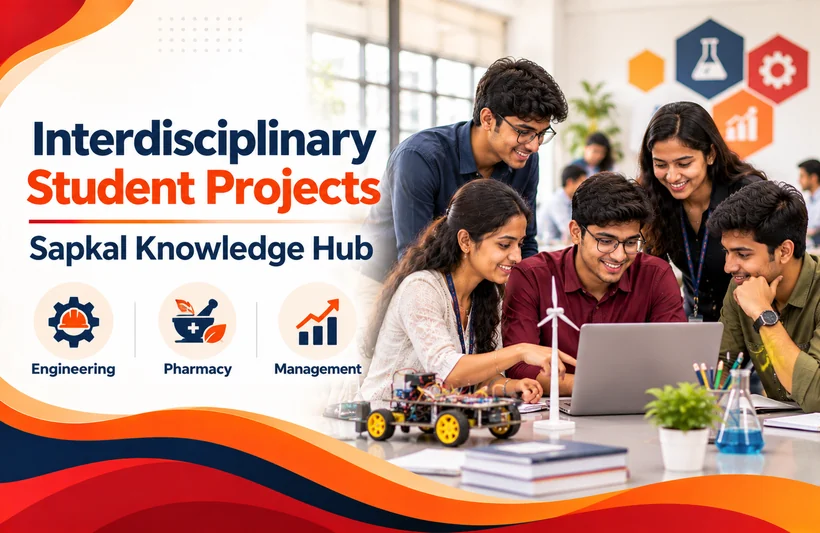
Interdisciplinary Student Projects at Sapkal Knowledge Hub
Modern professional challenges often require knowledge from more than one academic field.
Engineering, Pharmacy, Management and other disciplines bring different skills and perspectives to solving practical problems.
Interdisciplinary student projects encourage students to combine these perspectives through teamwork, scientific reasoning and collaborative learning.
At Sapkal Knowledge Hub, Nashik, different professional institutions operate within a shared educational campus, offering a relevant environment for exploring interdisciplinary learning.
This guide explains the importance of interdisciplinary projects, possible collaboration areas and the skills students can develop.
1. What Are Interdisciplinary Student Projects?
Interdisciplinary projects are academic activities that combine knowledge or methods from two or more fields.
For example, a healthcare-related problem may involve scientific understanding, technology and business planning.
Students working across disciplines can contribute different technical and analytical perspectives.
Such projects require clear objectives, appropriate supervision and defined responsibilities.
2. Why Interdisciplinary Learning Matters
Real-world challenges rarely fit into a single academic subject.
Product development, healthcare innovation and sustainable infrastructure may involve several professional disciplines.
Interdisciplinary learning encourages students to consider problems from different viewpoints.
It can also help them understand how specialist knowledge contributes to a shared objective.
3. Project-Based Learning at Sapkal Knowledge Hub
Sapkal Knowledge Hub's official website describes internships, industry-oriented projects, research activities and live assignments as part of its practical learning approach.
The campus brings together institutions offering Engineering, Pharmacy and Management education.
Its published project information highlights problem-solving, teamwork, creativity and communication.
Specific cross-institute projects should be identified as completed only when supported by official project records.
4. Engineering and Technology Perspectives
Engineering students learn to approach technical problems through design, analysis and practical implementation.
Depending on their specialisation, project work may involve software, electronics, manufacturing, infrastructure or data analysis.
These skills can contribute to broader interdisciplinary challenges.
Students must follow their prescribed curriculum and approved project requirements.
5. Pharmacy and Healthcare Perspectives
Pharmacy education introduces students to pharmaceutical sciences, medicines, laboratory methods and professional responsibilities.
Students may develop knowledge relevant to healthcare technology, pharmaceutical quality and scientific research.
Collaboration with technical disciplines can encourage discussion of practical healthcare-related challenges.
Medical or pharmaceutical applications must follow appropriate safety, ethical and regulatory requirements.
6. Management and Business Perspectives
Management education introduces concepts such as planning, market research, operations, finance and entrepreneurship.
These areas can complement technical and scientific projects.
For example, students studying business concepts can evaluate the feasibility and organisational requirements of an innovation.
Such evaluation can help project teams understand considerations beyond technical development.
7. Examples of Potential Interdisciplinary Project Themes
The following are illustrative project ideas, not claims of completed projects at Sapkal Knowledge Hub:
-
A digital inventory-management concept for healthcare supplies
-
An educational application explaining medicine safety
-
A sustainability assessment for campus resource use
-
A technology-enabled student services prototype
-
A market-feasibility study for a student innovation
Each idea would require an approved project scope, appropriate guidance and relevant permissions.
8. Importance of Teamwork in Student Projects
Collaborative projects require students to communicate clearly and coordinate responsibilities.
Team members may bring different technical knowledge, terminology and working methods.
Effective teamwork involves listening, sharing progress and resolving disagreements constructively.
These abilities can be useful in academic and professional environments.
9. Developing Problem-Solving Skills
Interdisciplinary projects encourage students to define a problem before proposing a solution.
A structured approach may involve reviewing existing research, identifying requirements and evaluating possible methods.
Students can also learn to consider the limitations of their ideas.
Faculty guidance helps ensure that project activities remain appropriate to the academic level.
10. Learning Research and Documentation
Research and documentation are important parts of academic project work.
Students should review reliable information sources and maintain accurate records of methods and findings.
Clear documentation can make a project easier to evaluate and improve.
Any reported results must reflect actual observations rather than assumptions or invented outcomes.
11. Innovation and Creative Thinking
Innovation can involve improving an existing process or exploring a new approach to a problem.
Students from different disciplines may identify possibilities that would be less obvious from a single perspective.
Academic projects provide opportunities to evaluate these ideas systematically.
Not every project needs to produce a commercial product to deliver educational value.
12. Understanding Ethical and Safety Responsibilities
Projects involving people, health information, biological materials or sensitive data may require additional oversight.
Students should understand applicable permissions, privacy requirements and laboratory safety procedures.
Ethical considerations should be addressed during planning rather than after project completion.
Supervision and institutional approval are particularly important for regulated activities.
13. Faculty Guidance and Mentorship
Faculty members play an important role in supervising academic projects.
They can help students refine project objectives, choose suitable methods and evaluate findings.
Projects spanning multiple disciplines may benefit from guidance relevant to each subject area.
Any particular joint mentorship arrangement should be confirmed through official institute records.
14. Industry-Oriented Projects and Practical Exposure
Sapkal Knowledge Hub describes industry-oriented assignments, research and internships within its practical learning framework.
Such activities can introduce students to workplace requirements and professional problem-solving.
The Central Training and Placement Cell also provides a contact point for organisations interested in industry projects and collaboration.
Availability depends on the programme, organisation and applicable academic arrangements.
15. Skills Developed Through Interdisciplinary Projects
Interdisciplinary learning can help students practise:
-
Communication and collaboration
-
Research and analytical thinking
-
Project planning and documentation
-
Technical problem-solving
-
Creativity and adaptability
-
Time management and professional responsibility
Students should be able to explain their genuine individual contribution when presenting project experience.
16. Preparing and Presenting a Student Project
An academic project should begin with a clearly defined objective.
Students can identify the intended problem, applicable knowledge areas and expected educational outcomes.
The next stages may involve research, planning, implementation, testing and documentation.
Final presentations should distinguish actual results from proposals and future possibilities.
17. Interdisciplinary Learning Across Sapkal Knowledge Hub
Sapkal Knowledge Hub brings together multiple institutions on its Nashik campus.
Students can explore academic information through Late G. N. Sapkal College of Engineering, R. G. Sapkal Institute of Pharmacy, R. G. Sapkal College of Pharmacy and K. R. Sapkal College of Management Studies.
The campus's Internships and Projects page describes the wider approach to practical education.
Students interested in cross-disciplinary projects should consult the appropriate academic departments about current opportunities.
Conclusion
Interdisciplinary student projects encourage learners to connect academic knowledge, collaborate across fields and approach problems from multiple perspectives.
Engineering, Pharmacy and Management each contribute different skills to practical challenges.
Sapkal Knowledge Hub's multi-institute environment and published project-based learning approach provide context for exploring these educational connections.
Students should select suitable project opportunities, work under appropriate guidance and document their actual learning experiences.
Frequently Asked Questions
1. What is an interdisciplinary student project?
It is an academic project that combines knowledge or methods from two or more disciplines to investigate a problem or develop a solution.
2. Why are interdisciplinary projects useful?
They can support teamwork, communication, critical thinking and the application of knowledge from different fields.
3. Which academic fields can contribute to interdisciplinary projects?
Engineering, Pharmacy, Management and other disciplines may contribute relevant knowledge depending on the project's objectives.
4. Does Sapkal Knowledge Hub support project-based learning?
Yes. Its official website describes industry-oriented projects, practical assignments, internships and research-related learning activities.
5. Are joint projects between different Sapkal institutes guaranteed?
No. Students should confirm actual cross-institute opportunities and approved project arrangements with the relevant departments.
6. How should students start an interdisciplinary project?
Students should identify a suitable problem, seek academic guidance, define responsibilities and follow approved project and safety requirements.