

Which Professional Courses Require Mathematics After 12th?
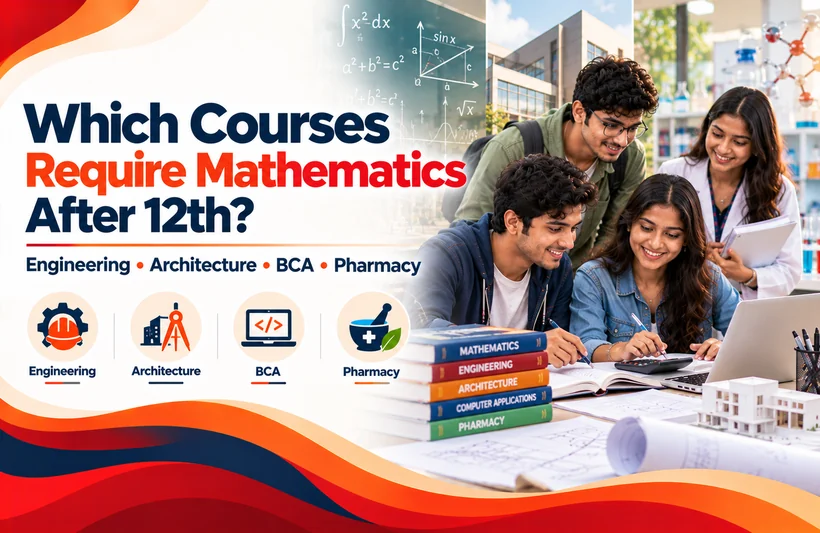
Which Professional Courses Require Mathematics After 12th?
Choosing a professional course after Class 12 depends on academic interests, career goals and subject eligibility.
One common question among Science students is which professional courses require Mathematics after 12th and whether students without Mathematics can explore similar career opportunities.
Mathematics is compulsory for certain programmes, while other courses accept Biology or follow institution-specific eligibility rules.
This guide from Sapkal Knowledge Hub, Nashik, explains important subject requirements and educational pathways.
1. Why Is Mathematics Important in Professional Education?
Mathematics provides a foundation for analytical thinking, calculations, problem-solving and quantitative reasoning.
It is particularly relevant to technical fields involving design, programming, engineering analysis and scientific modelling.
However, studying Mathematics does not automatically make a student eligible for every professional programme.
Applicants must meet the complete eligibility criteria prescribed by the relevant authority.
2. Engineering Courses After 12th
Engineering programmes involve the application of scientific and mathematical concepts to technology, infrastructure and technical systems.
Common branches include Computer Engineering, Mechanical Engineering, Civil Engineering, Electrical Engineering and Electronics Engineering.
Mathematics is compulsory for many traditional Engineering admission pathways.
Maharashtra's 2026–27 Engineering admission rules include Physics and Mathematics as compulsory subjects under the principal eligibility route.
Other specified subject combinations and branch-specific provisions may apply under the official rules.
3. Is Mathematics Compulsory for B.Tech?
For the conventional B.E./B.Tech route in Maharashtra, Physics and Mathematics are important compulsory subjects.
However, students should not assume that every Engineering branch follows exactly the same eligibility provisions.
The official admission brochure may identify additional pathways for particular branches.
Students must verify the requirements applicable to the intended programme before applying.
4. Mathematics Requirements for Architecture
Bachelor of Architecture (B.Arch) is a professional degree focused on building design and the built environment.
The Council of Architecture's 2026 admission framework requires Mathematics as a compulsory subject through the eligible qualifying routes.
Candidates applying through Class 12 must meet the prescribed subject combination and aggregate marks requirements.
An eligible 10+3 diploma pathway with Mathematics is also specified.
Applicants must satisfy applicable architecture aptitude and admission requirements.
5. Computer Science and Information Technology Courses
Computer Science and Information Technology education involves programming, computational thinking, algorithms and software systems.
Mathematics is especially relevant to subjects involving logic, discrete mathematics, data structures and computational methods.
Many B.Tech Computer Science programmes use the applicable Engineering Mathematics eligibility route.
For non-Engineering computing degrees, the requirements may differ.
6. Is Mathematics Compulsory for BCA?
Bachelor of Computer Applications (BCA) focuses on computing, programming and software-related subjects.
Mathematics is useful for BCA studies, but it is not universally compulsory at Class 12 across every university.
Some institutions may require Mathematics or another specified subject, while others may admit students from different eligible streams.
Students should check the latest university and admission authority requirements.
7. Artificial Intelligence and Data Science
Artificial Intelligence and Data Science involve mathematics, statistics, programming and data analysis.
Students interested in B.Tech programmes in these specialisations must follow the applicable Engineering admission requirements.
Mathematics provides a useful foundation for machine learning, data modelling and algorithmic concepts.
Other recognised educational pathways in data science may have different admission conditions.
8. Is Mathematics Compulsory for Pharmacy?
Mathematics is not universally compulsory for admission to B.Pharm.
The Pharmacy Council of India's published B.Pharm eligibility provisions accept Physics and Chemistry with either Mathematics or Biology, subject to other requirements.
This means eligible PCM and PCB students may explore Bachelor of Pharmacy.
Students must also satisfy applicable entrance examination, marks and admission conditions.
9. Diploma in Pharmacy After 12th
Diploma in Pharmacy (D.Pharm) is a professional diploma programme in pharmaceutical education.
Its eligibility framework includes 10+2 Science with Physics and Chemistry together with Biology or Mathematics.
Students should verify the current admission requirements and qualification recognition.
Mathematics is therefore not compulsory for every eligible D.Pharm candidate.
10. Mathematics and Management Courses
Management programmes introduce subjects such as business operations, economics, marketing, finance and organisational behaviour.
Undergraduate Management eligibility depends on the programme and institution.
Some courses accept students from different Class 12 streams.
Although Mathematics can be helpful for quantitative subjects, it may not be an admission requirement.
11. Mathematics in Commerce and Finance Education
Students interested in Finance, Accounting and Commerce may encounter mathematical or statistical concepts.
However, requirements differ among B.Com, BBA and other specialised degree programmes.
Some institutions prescribe particular Class 12 subjects.
Students should verify eligibility rather than assuming Mathematics is mandatory or unnecessary everywhere.
12. Mathematics in Agricultural and Technical Programmes
Agriculture-related professional courses have different subject requirements.
Maharashtra's 2026 entrance brochure distinguishes between programmes accepting PCM or PCB and programmes requiring particular subject groups.
For example, B.Tech Agricultural Engineering follows the PCM examination route under the published 2026 requirements.
Applicants should consult the programme-specific brochure.
13. Quick Comparison of Mathematics Requirements
| Professional course | Mathematics requirement |
|---|---|
| B.E./B.Tech | Required in the conventional route; check branch-specific provisions |
| B.Arch | Compulsory through the prescribed qualifying pathways |
| B.Tech Computer Science | Follow applicable Engineering eligibility |
| B.Tech AI and Data Science | Follow applicable Engineering eligibility |
| BCA | Varies by institution and university |
| B.Pharm | Mathematics or Biology accepted |
| D.Pharm | Mathematics or Biology accepted |
| BBA | Generally institution-specific |
| B.Com | Varies by institution and programme |
| B.Tech Agricultural Engineering | PCM required under Maharashtra's 2026 entrance framework |
This table is a general guide, not a substitute for the current admission brochure.
14. Career Options for PCM Students
Students who have studied Physics, Chemistry and Mathematics can explore several educational pathways.
These may include Engineering, Architecture, Computer Science, Physical Sciences and other eligible programmes.
Depending on the admission rules, PCM students can also consider Pharmacy and Management.
The appropriate choice depends on individual interests and academic strengths.
15. Career Options for PCB Students
Students with Physics, Chemistry and Biology can explore several healthcare and science-related programmes.
Examples include Pharmacy, Medicine, Dentistry, Nursing, Biotechnology and Life Sciences, subject to relevant eligibility and entrance requirements.
Some technical programmes may also have additional eligible pathways.
Students should not assume that every Engineering course is open to PCB applicants without checking its specific rules.
16. What About PCMB Students?
Students who have completed Physics, Chemistry, Mathematics and Biology may satisfy the subject requirements for a broader selection of programmes.
However, they must still meet entrance examination, marks and other admission conditions.
Having all four Science subjects does not guarantee admission.
17. How to Select the Right Course
Students should compare their academic strengths and long-term goals before choosing a programme.
Useful questions include:
-
Do I enjoy Mathematics and technical problem-solving?
-
Am I more interested in technology, medicines or business?
-
Which subjects are compulsory for my preferred course?
-
What entrance examination do I need to take?
-
Is the programme recognised by the applicable authority?
-
What higher education pathways are available?
Official admission information should guide the final decision.
18. Exploring Courses at Sapkal Knowledge Hub Nashik
Sapkal Knowledge Hub brings together institutions offering professional education in Engineering, Pharmacy, Management and Computer Applications.
Students interested in Engineering can explore Late G. N. Sapkal College of Engineering.
For Pharmacy education, students can visit R. G. Sapkal College of Pharmacy or R. G. Sapkal Institute of Pharmacy.
Students exploring Computer Applications or Management can review K. R. Sapkal College of Management Studies.
Course eligibility, approvals and admission availability should be confirmed through the relevant institution.
Conclusion
Mathematics is an important subject for many professional education pathways, particularly Engineering and Architecture.
However, it is not compulsory for every course after Class 12.
B.Pharm and D.Pharm accept eligible students with Mathematics or Biology, while BCA and Management eligibility may differ between institutions.
Students should consult official admission requirements before selecting a course and build their decisions around academic interests and career goals.
Frequently Asked Questions
1. Which professional courses require Mathematics after 12th?
Mathematics is required for several Engineering and Architecture admission pathways. Exact requirements depend on the programme and applicable rules.
2. Is Mathematics compulsory for B.Pharm?
No. PCI regulations allow the prescribed qualifying subjects with either Mathematics or Biology.
3. Can PCB students pursue Engineering?
Some pathways may exist depending on the branch and admission rules. Applicants must check the official programme-specific requirements.
4. Can students study BCA without Mathematics?
Some institutions admit eligible students without Class 12 Mathematics, while others may specify subject requirements.
5. Is Mathematics necessary for Artificial Intelligence?
Mathematics is important for studying AI, while formal admission requirements depend on the chosen programme.
6. Can PCM students apply for Pharmacy?
Yes. Eligible PCM students can apply for B.Pharm or D.Pharm when they meet the other prescribed requirements.